


 by
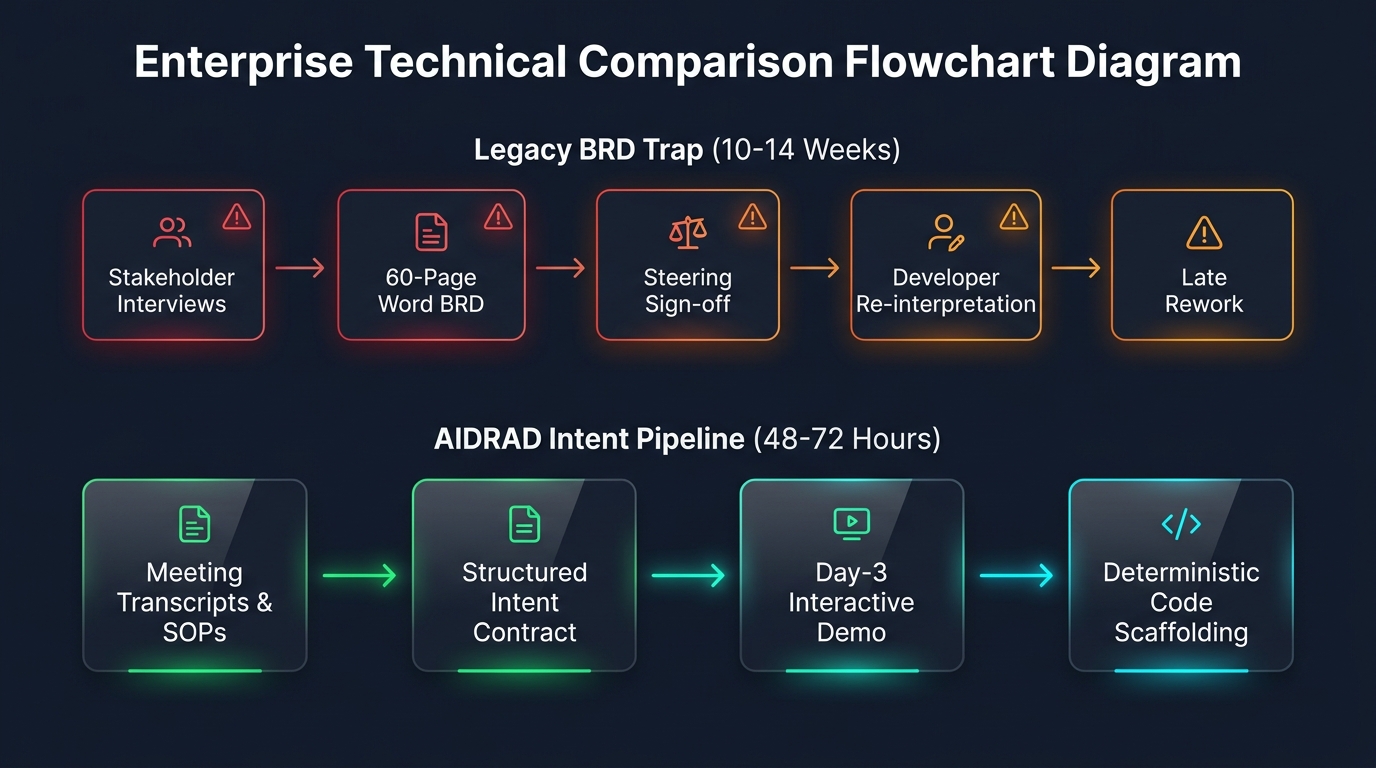
In traditional enterprise IT, the Business Requirement Document (BRD) is treated as a sacred milestone. It represents weeks—often months—of stakeholder interviews, steering committee reviews, cross-departmental sign-offs, and endless versioning (BRD_v2.4_FINAL_reviewed_DO_NOT_EDIT.docx).
Yet, every seasoned CTO and engineering director knows the unspoken truth about 60-page BRDs:
- Nobody actually reads them in their entirety. Executives skim the executive summary, developers search for API tables, and business analysts argue over footnotes.
- English prose is fatally ambiguous. Words like “seamlessly integrate”, “fast response time”, and “user-friendly dashboard” mean five completely different things to the compliance officer, the frontend engineer, and the VP of Operations.
- They are frozen artifacts in a fluid world. By the time a 70-page BRD navigates a 10-week corporate approval cycle, business priorities have shifted, regulatory deadlines have moved, and the document is obsolete before a single line of backend code is committed.
In our earlier exploration of why internal applications should not take months anymore and our recent breakdown on reassembling complex document scans locally using deterministic logic, we demonstrated that modern automation eliminates mechanical execution bottlenecks. The true bottleneck in enterprise software delivery has shifted entirely to the intent-capture layer.
In the AIDRAD (AI-Driven Rapid App Delivery) framework, we do not write narrative BRDs. We practice Structured Intent Engineering.
1. From Prose Documents to Executable Intent Contracts
Structured Intent Engineering is not a prompt, a Jira story, or a shortened Word document. It is a machine-executable, declarative state contract that defines exactly what an application must do, what invariants it must preserve, and what data schemas it accepts, without dictating how individual functions are written.
flowchart LR
    A["📋 Stakeholder Input
Conversations & Docs"] --> B["⚙️ Intent Synthesis
Pydantic Typing & Schema"]
    B --> C["📐 Machine-Readable Intent
JSON / YAML Specification"]
    C --> D["⚡ Day-3 Interactive Demo
Tactile Validation Gate"]
    D --> E["🚀 Scaffolding Engine
Deterministic Code Scaffolding"]

    style A fill:#1e293b,stroke:#f87171,stroke-width:2px,color:#f8fafc
    style B fill:#1e293b,stroke:#a855f7,stroke-width:2px,color:#f8fafc
    style C fill:#1e293b,stroke:#38bdf8,stroke-width:2px,color:#f8fafc
    style D fill:#1e293b,stroke:#f59e0b,stroke-width:2px,color:#f8fafc
    style E fill:#064e3b,stroke:#34d399,stroke-width:2px,color:#f8fafc
📋 Click to view / copy raw Mermaid source
flowchart LR
    A["Stakeholder Input (Conversations & Docs)"] --> B["Intent Synthesis (Pydantic Typing & Schema)"]
    B --> C["Machine-Readable Intent (JSON/YAML Contract)"]
    C --> D["Day-3 Interactive Demo (Tactile Validation Gate)"]
    D --> E["Scaffolding Engine (Deterministic Code Scaffolding)"]
As we outlined in our blueprint for the Intent to Demo to Harden to Go-Live lifecycle, an application is only as healthy as the fidelity of its initial contract. When intent is structured, ambiguity vanishes.
2. The Anatomy of an Intent Contract
Instead of narrative paragraphs, an Intent Contract consists of five rigorous components written in structured formats (YAML or JSON Schema):
- Boundary Constraints (The “Never” Rules): Hard security, residency, and role-based policies that the application can never violate under any condition (e.g., “Under zero circumstances may unmasked tax IDs be rendered to Tier-1 support roles”).
- State Machines & Transitions: Explicit states, allowable triggers, and state prerequisites. You eliminate paragraphs of narrative workflow rules by simply specifying valid state graphs.
- Entity Invariants: Immutable mathematical or logical relationships (e.g.,
LineItemTotal == Sum(Items) + Tax - Discount;DisbursementDate >= ApprovalDate). - Observable Inputs & Outputs: Concrete payloads, expected status codes, and error schemas.
- Automated Acceptance Verification: Given/When/Then assertions that can be executed directly by test runners without human interpretation.
3. Real-World Comparison: BRD vs. Intent Contract
To see how this works in practice, examine how a standard corporate expense approval rule is captured in both formats:
The Legacy BRD (Ambiguous Prose)
“Section 4.3.2: Any expense claim exceeding standard operational limits should automatically escalate to senior management for expedited review. Managers must be notified immediately via appropriate channels and must review compliance before approving funds.”
The failure points: What constitutes a “standard operational limit”? Does senior management mean Director or VP? What are “appropriate channels”—Teams, Email, SMS? What does “expedited review” enforce in code? Three engineers will build three contradictory implementations.
The AIDRAD Intent Contract (Machine-Executable YAML)
intent_id: "expense_approval_escalation"
version: "1.0.0"
trigger: "expense.submission.created"

invariants:
  - id: "INV_01"
    rule: "claim.amount_usd <= 0 => REJECT_IMMEDIATELY"
  - id: "INV_02"
    rule: "claim.submitter_id != claim.approver_id"

state_transitions:
  initial_state: "SUBMITTED"
  rules:
    - condition: "claim.amount_usd < 5000"
      target_state: "PENDING_MANAGER_APPROVAL"
      required_role: "DirectManager"
      sla_hours: 48
      notifications: ["email", "teams_card"]

    - condition: "claim.amount_usd >= 5000"
      target_state: "PENDING_VP_APPROVAL"
      required_role: "DepartmentVP"
      sla_hours: 24
      notifications: ["email", "teams_high_priority", "push"]

acceptance_tests:
  - scenario: "High value claim routing"
    given: { "amount_usd": 7500, "submitter_role": "Engineer" }
    expect: { "target_state": "PENDING_VP_APPROVAL", "sla_hours": 24 }
4. Why AI Execution Engines Require Structured Intent
Large language models and modern autonomous coding agents are notoriously fragile when handed 60-page narrative Word documents. They suffer from context drift, hallucinate edge cases to fill narrative blanks, and miss buried caveats on page 42.
However, when fed a Structured Intent Contract:
- Code Generation is Deterministic: The agent generates the exact SQL migration, the FastAPI/C# backend controllers, and the UI state machines with 99% accuracy because the invariants and schemas are mathematically bounded.
- Test Generation is Automatic: The
acceptance_testsblock compiles straight into executable test suites (PyTest or xUnit) before code generation even begins. - Stakeholder Review is Immediate: Instead of asking business users to sign off on abstract text, we use the intent contract to instantiate a clickable, day-3 mock prototype. Business leaders validate real workflows in an interactive UI rather than guessing what a 20-page document means.
This is the fundamental engine that enables compressing the SDLC from months to weeks without sacrificing enterprise rigor.
Executive Takeaways: The CTO’s Intent Shift
- Kill BRD Review Latency: Requirement cycles drop from 8–12 weeks of Word document ping-pong to a 48-hour collaborative intent schema definition.
- Eliminate “That’s Not What I Asked For”: Ambiguity is caught in the schema validation phase, not four months later during User Acceptance Testing (UAT).
- Automate Audit & Governance: An intent contract doubles as an immutable regulatory audit trail. When auditors ask why a transaction routed to a VP, the system cites the exact intent schema version that governed the release.
In Part 2 of the AIDRAD Foundation Series, we will show how to feed messy corporate communication—meeting transcripts, emails, and legacy SOPs—into an autonomous pipeline that extracts structured intent contracts automatically.